Once merely a legal obligation, workplace health prevention is now emerging as a strategic driver.
It's no longer just about complying with the law, but about proactively and sustainably caring for teams. Investing in prevention has become essential.
Why? Workplace absenteeism is sharply rising, with a 26% increase since 2019, 85% of which is due to illness(1). Meanwhile, 80% of employees consider workplace well-being policies a decisive factor in choosing or staying in their job(2). Furthermore, companies investing in well-being programs can increase employee productivity by 20%(3).
But how can this be achieved in practice? What is the role of occupational health services, and how far can one go to meet the specific needs of employees?
Here are some guidelines for building a relevant and impactful health prevention approach.
The Crucial Role of Occupational Health Services
Occupational health services are a key player in prevention. They monitor employee health, advise employers, and participate in professional risk assessment.
However, despite this central role, they cannot do everything. Occupational health physicians face structural challenges: staffing shortages, time constraints, and a scope of intervention defined by regulations. In this context, it sometimes becomes difficult to meet all prevention needs within companies.
Furthermore, the organization of the occupational health system can vary from one company to another. In inter-company occupational health services, there is an average of 1 doctor for every 4,789 employees, compared to 1 doctor for every 1,658 employees in autonomous services (i.e., internal to the company). This highlights how much access to prevention resources can vary depending on the size and structure of organizations.
Therefore, it is recommended to supplement this mission with other initiatives.
Organizing Prevention Campaigns
One-off prevention campaigns help raise awareness among teams on key topics. Workshops, webinars, themed days... The formats are varied and adaptable throughout the year:
- In January, a campaign on healthy resolutions or Dry January;
- In March, awareness on addictions;
- In October, a focus on breast cancer...
To do this, it is possible to call on healthcare professionals, collaborate with occupational health services, or rely on specialized organizations.
However, these actions, although valuable, can have limitations:
- Employee engagement often remains uneven;
- They are often perceived as one-off operations without follow-up;
- Their impact is difficult to measure in the long term.
Opting for Specific Solutions
Some companies go further by developing actions dedicated to specific issues:
- Mental health : psychological support, stress management, burnout prevention.
- Women's Health : endometriosis, menopause, contraception, parenthood.
- Other populations addressed for their specific health concerns : new parents, night shift workers, seniors…
This is a more targeted, personalized approach, but it doesn't always concern all employees. Moreover, by focusing on a single topic, there's a risk of overlooking other equally important health issues.
Offer a comprehensive and accessible health check-up for personalized prevention
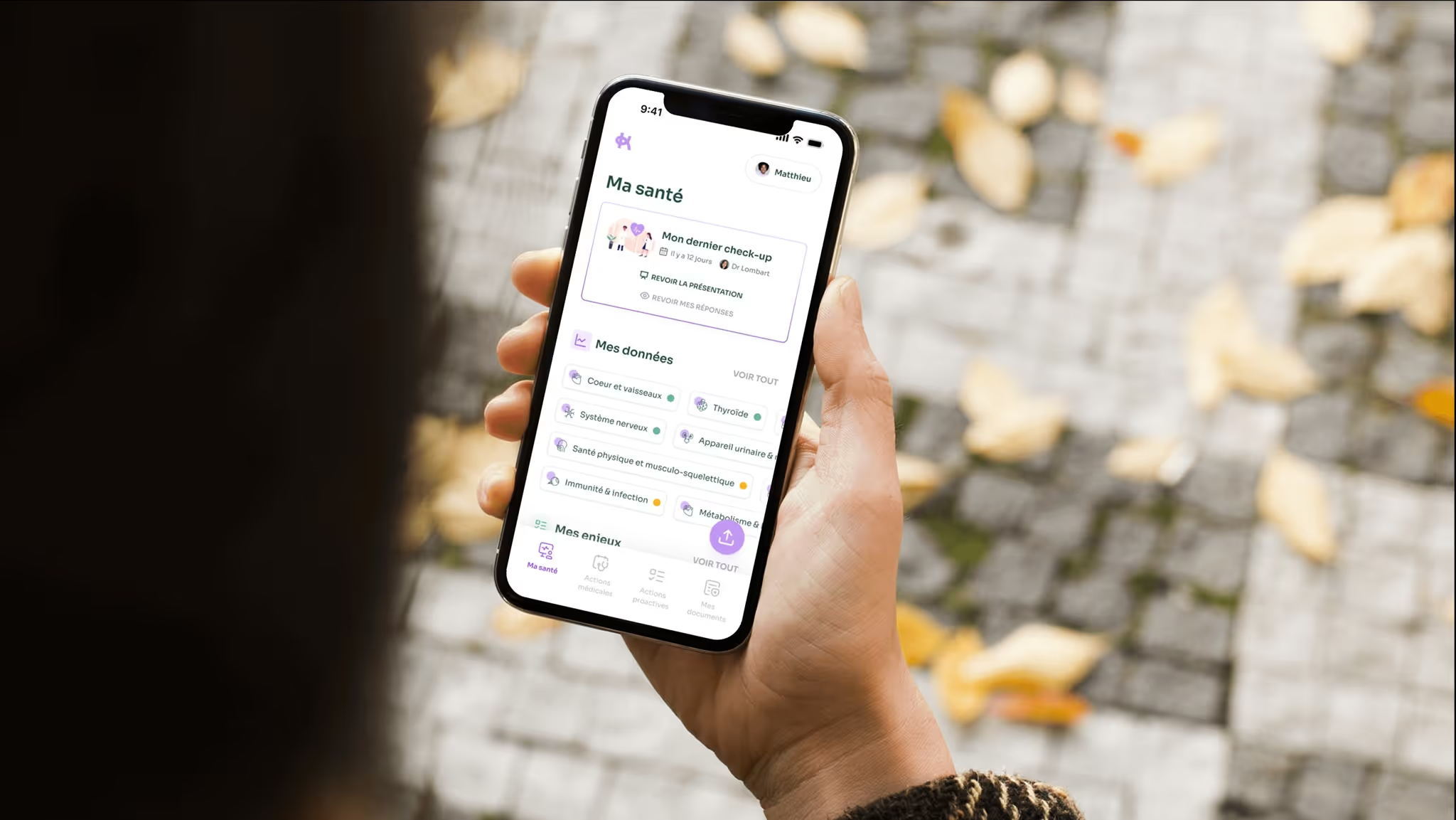
To go further, some companies now offer comprehensive health check-ups to their employees. More personalized than the mandatory medical examination, the health check-up allows each individual to receive prevention tailored to their profile, age, lifestyle, and medical history.
At Kor, we support companies in this endeavor by offering them a turnkey solution for health check-ups , to be deployed to employees in various formats: digital, on-site or in a center. This modular approach allows us to adapt to the needs and constraints of each company, while covering all priority health topics: cardiovascular, mental, nutrition, sleep, addictions, sexual health…
Read our article: Everything you need to know about corporate health check-ups
Our approach is complementary to the actions of occupational health services. We work in coordination with their teams, whenever possible, to offer a coherent pathway and strengthen the overall impact of corporate prevention.
Whether it's a digital check-up accessible to everyone, a targeted assessment directly at the workplace, or an in-depth medical center assessment, our goal remains the same: to offer personalized, proactive, and engaging prevention for each employee.
The result: more proactive, equitable, and effective prevention that addresses both HR challenges and individual expectations.
How to make health prevention a performance driver for your company?
But implementing prevention actions is not enough. For them to have a real impact on company performance, they must also be strategically planned. So, how can health prevention become a true driver of sustainable performance?
To transform health prevention into a driver of sustainable performance, certain key elements are essential:
- Prevention that is comprehensive: by covering all major health conditions, thus ensuring all employees are reached.
- Prevention that is accessible: easy to implement, flexible, and financially sustainable.
- Prevention that is personalized : an approach that adapts to the specific needs of each employee to maximize engagement.
- Prevention that is impactful : not being limited to one-off operations without follow-up, but rather engaging employees in a sustainable dynamic where everyone becomes an active participant in their own health.
- Prevention that is supported : a turnkey deployment and a report of key KPIs.
Getting support for your prevention strategy
Conclusion
Workplace health prevention is no longer just a legal posting or an annual information day. It's a strategic investment for companies looking to build a culture of care, sustainable performance, and engagement.
The good news? There isn't just one right way to do it. But one thing is certain: the more the approach is tailored, consistent, and personalized, the greater its impact.
What if you made health prevention your next HR lever?
Sources
(1) Institut Sapiens, 2018
(2) 16th Absenteeism and Engagement Barometer, Ayming x AG2R La Mondiale, 2024 study
(3) Employee Wellness Statistics, Electroic