Cardiovascular diseases are the leading cause of death worldwide and among the main causes of death in France. Yet, a large proportion of premature cardiovascular events could be prevented: studies suggest that between 55% and 80% of them could be avoided by acting early on the right risk factors.
This guide helps you understand your cardiovascular health, identify risk factors — primarily high blood pressure — and discover how to assess your risk of cardiovascular disease in 30 seconds with Kor.
Cardiovascular Health: A Major Public Health Challenge
Cardiovascular diseases — myocardial infarction, stroke, heart failure — are the leading cause of death worldwide. In France, they claim 140,000 lives each year, or one life every four minutes.
According to theWorld Health Organization (WHO), up to 80% of heart attacks and strokes before the age of 70 could be prevented, through two complementary approaches: lifestyle (smoking, diet, physical activity) and the early detection of risk factors, such as high blood pressure or high cholesterol.
While scientific knowledge on cardiovascular prevention is now robust, the main challenge remains operational: translating this knowledge into concrete actions for the widest possible audience. Until now, a comprehensive cardiovascular check-up required a doctor's office, a blood pressure cuff, an appointment, and sometimes biological analyses — all logistical constraints that often delay action, even among those aware of the stakes.
What is a cardiovascular check-up?
A cardiovascular check-up is a medical evaluation that identifies abnormalities in the cardiovascular system (heart and blood vessels) and risk factors before a disease manifests itself. It is part of a strategy of prevention : early detection for early intervention, and ideally, never having to treat an established disease.
What does a comprehensive cardiovascular check-up measure?
A comprehensive cardiovascular check-up may include:
- the blood pressure
- the heart rate and the heart rate variability
- the respiratory rate
- a lipid panel (total cholesterol, LDL, HDL, triglycerides)
- a glucose panel (fasting glucose, HbA1c)
- assessment of personal and family history
- an overall cardiovascular risk score (for example, the SCORE2 score, recommended by the European Society of Cardiology for ages 40-69, and SCORE2-OP for those over 70)
At what age should you have your cardiovascular check-up?
European guidelines recommend initial screening for cardiovascular risk factors:
- starting at age 40, for both men and women.
- in the presence of risk factors (smoking, overweight, diabetes, family history), screening should be initiated earlier, regardless of sex.
- to be repeated every 4 to 6 years in the absence of risk factors, or more frequently if an anomaly is detected, new risk factors emerge, or treatment is ongoing.
High blood pressure, the primary modifiable risk factor
Among all cardiovascular risk factors, high blood pressure holds a unique position: it is one of the most common, one of the most serious... and one of the most silent.
What is high blood pressure?
High blood pressure (hypertension) refers to a chronic elevation of blood pressure in the arteries. Hypertension is diagnosed when blood pressure is greater than or equal to 140/90 mmHg when measured in a doctor's office, or 135/85 mmHg with home self-monitoring (according to the protocol: two measurements in the morning and two in the evening, for 3 to 7 consecutive days, using a validated device, before taking any medication).
It most often remains asymptomatic for years while progressively damaging the arteries, heart, kidneys, and brain.
Who is affected by high blood pressure?
In France, one in three adults has high blood pressure, and nearly six in ten are unaware they have it. The main risk factors are:
- age (the risk increases after 40)
- a family history of high blood pressure
- overweight and obesity
- a sedentary lifestyle
- a diet high in salt
- excessive alcohol consumption
- smoking active or secondhand
- chronic stress and lack of sleep
What are the risks of untreated high blood pressure?
Undetected or untreated high blood pressure significantly increases the risk of:
- heart attack
- stroke (CVA)
- heart failure
- chronic kidney failure
- cognitive impairment and vascular dementia
Precisely because high blood pressure can silently damage the body, early screening is essential — even, and perhaps especially, in the absence of symptoms.
How is high blood pressure diagnosed?
Diagnosing hypertension relies on repeated blood pressure measurements taken with an approved device. The typical process involves:
- Risk assessment via screening tools: questionnaires, non-invasive examinations such as Kor's vital signs scan.
- Blood pressure measurement at the doctor's office, pharmacy, occupational health service, or through self-measurement at home.
- In case of repeated high blood pressure, a MAPA (24-hour ambulatory blood pressure monitoring) may be prescribed to confirm the diagnosis.
- Diagnosis and management by a doctor.
How is high blood pressure treated?
Hypertension management typically combines:
- lifestyle and dietary measures : salt reduction, regular physical activity, weight loss if necessary, smoking cessation, alcohol limitation, stress and sleep management.
- medication prescribed by a doctor (ACE inhibitors, sartans, diuretics, beta-blockers, calcium channel blockers, etc.) when lifestyle changes are not enough.
When well-managed, hypertension can be controlled long-term and cardiovascular risk significantly reduced (20 to 30% for a 10 mmHg drop in systolic pressure), even if it doesn't always return to the level of someone who has never had hypertension.
Other cardiovascular risk factors
Beyond hypertension, several factors increase cardiovascular risk and are included in a comprehensive cardiovascular assessment:
- dyslipidemia (high LDL cholesterol, low HDL, hypertriglyceridemia)
- diabetes (type 1 or type 2)
- smoking (active or passive)
- sedentary lifestyle
- overweight and abdominal obesity
- family history of early cardiovascular events
- the chronic stress and sleep disorders
A well-conducted cardiovascular assessment allows for the evaluation of each of these factors and the development of a personalized action plan.
Assess your cardiovascular risk with Kor: 30 seconds to get started
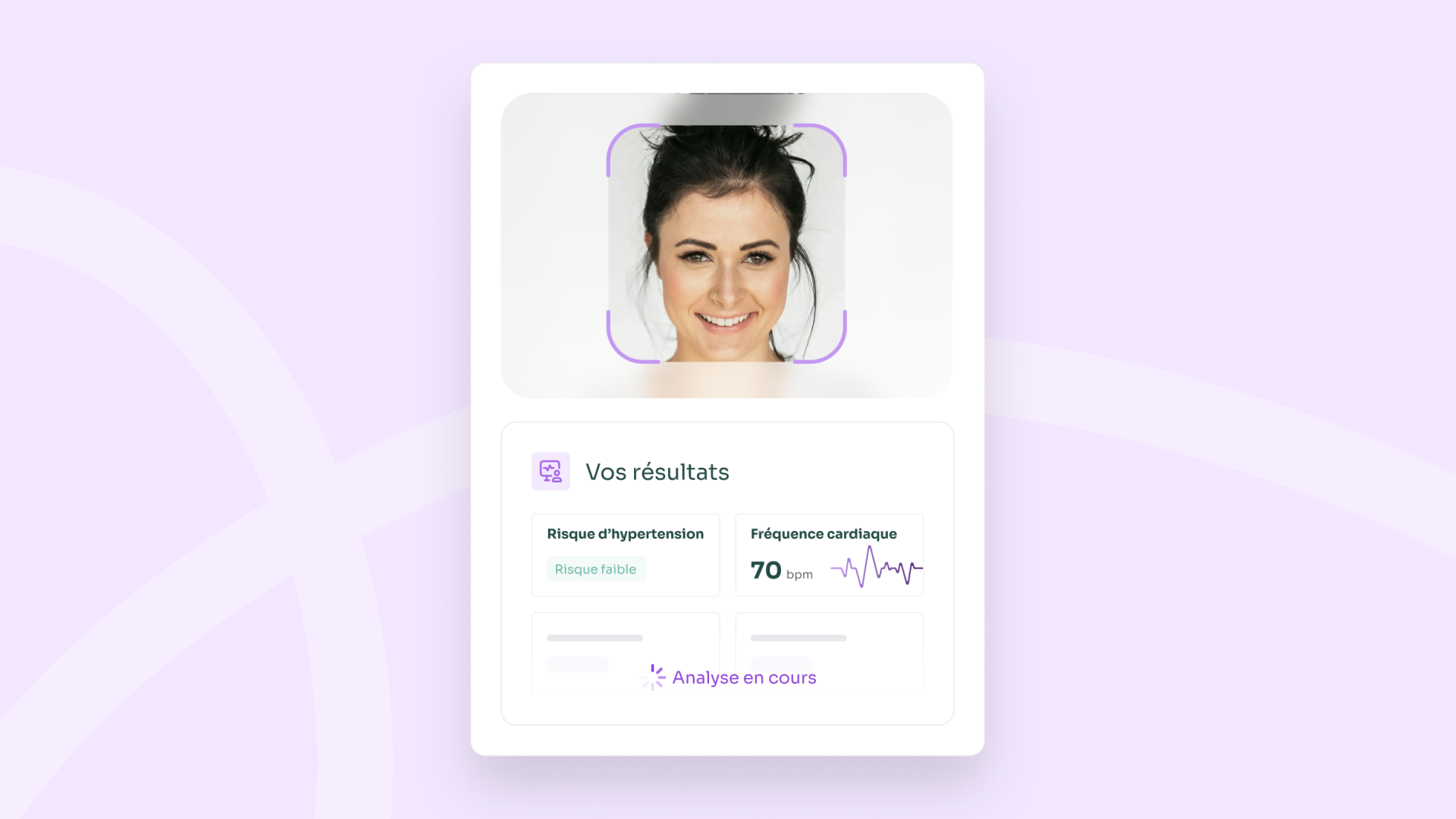
Kor's vital signs scan is an online cardiovascular test, accessible directly from the Kor app — on phone or computer. In 30 seconds, through a simple video recording of your face, it measures:
- your heart rate
- your respiratory rate
- your heart rate variability (HRV) : an indicator of the autonomic nervous system reflecting your level of recovery and stress — a high HRV indicates good adaptability, while a low HRV can signal chronic stress or accumulated fatigue
- your risk of high blood pressure
How does the vital signs scan work?
Your device's camera analyzes micro-variations in skin color, invisible to the naked eye, linked to subcutaneous blood flow — a technology called rPPG (remote photoplethysmography). These signals are cross-referenced with your personal data (age, gender, height, weight) and processed by anartificial intelligence model to estimate, in particular, your risk of high blood pressure.
A Scientifically Validated Medical Device
Kor's vital signs scan is a Class IIa Medical Device, CE marked, approved by Kor's scientific committee. The AI model used to estimate hypertension risk has been validated on 1,200 real cases, with reference measurements taken by medical cuffs (the gold standard).
Note: this test is not intended to replace a blood pressure measurement taken with an approved device. It is an prevention and awareness tool, that helps detect a risk and guide towards the appropriate care pathway — not to make a diagnosis.
What happens after the scan?
The vital signs scan is part of Kor's overall health check-up. After the test, you will receive:
- clear results, accompanied by educational content written by Kor doctors
- personalized recommendations on lifestyle (sleep, physical activity, nutrition, stress management...)
- if a high risk is detected, a referral to a care pathway (general practitioner, pharmacist, occupational health services), and, if desired, appointment booking assistance
FAQ — Online Cardiovascular Assessment
Can you really assess your cardiovascular risk online?
Yes, partially. Several cardiovascular parameters (heart rate, variability, hypertension risk) can now be measured remotely, via video scan, without specific equipment. This does not replace a complete medical check-up — which includes an approved blood pressure measurement and biological analyses — but it is an excellent first step for screening and awareness.
At what age should you have your first cardiovascular assessment?
European recommendations suggest a first screening from age 40, for both men and women. In the presence of risk factors (smoking, overweight, diabetes), it is advisable to start earlier, regardless of sex.
Is Kor's video scan reliable?
Kor's vital signs scan is a Class IIa Medical Device, CE marked. The AI model for hypertension risk estimation has been validated on 1,200 real cases, using medical cuffs as reference. To confirm a diagnosis of hypertension, a measurement with an approved device remains necessary.
How long does an online cardiovascular assessment take?
Kor's vital signs scan takes 30 seconds — that's the duration of the video recording. Results are delivered immediately afterwards. For a more complete assessment including biological analyses, allow a few days.
Is the cardiovascular assessment reimbursed?
Part of the cardiovascular assessment (medical consultation, prescribed biological analyses) is covered by the national health insurance (Assurance Maladie) and supplementary health insurance. The Kor check-up, which includes the vital signs scan, is fully covered as part of partner companies and supplementary health insurance plans.
Does the scan replace a medical consultation?
No. The scan is a prevention and awareness tool. In case of abnormal results or doubt, a consultation with a healthcare professional remains essential. The Kor medical team will guide you towards the appropriate care pathway.
Taking care of your heart is taking care of everything else.
Cardiovascular health isn't only about your heart. Good cardiovascular health is closely linked to better daily energy, preserved sleep quality, optimal brain function, and lasting kidney health. Taking care of your heart is a direct investment in your healthy years — and it's one of the best health decisions you can make, at any age.
To get your first cardiovascular assessment in 30 seconds, create your account on app.kor.care.
Article written by the Kor medical team.
Sources: World Health Organization (WHO), French National Authority for Health (HAS), French Society of Cardiology (SFC), European Society of Cardiology (ESC), European Society of Hypertension (ESH), American College of Cardiology/American Heart Association (ACC/AHA), French National Institute of Health and Medical Research (Inserm).



.avif)

.avif)