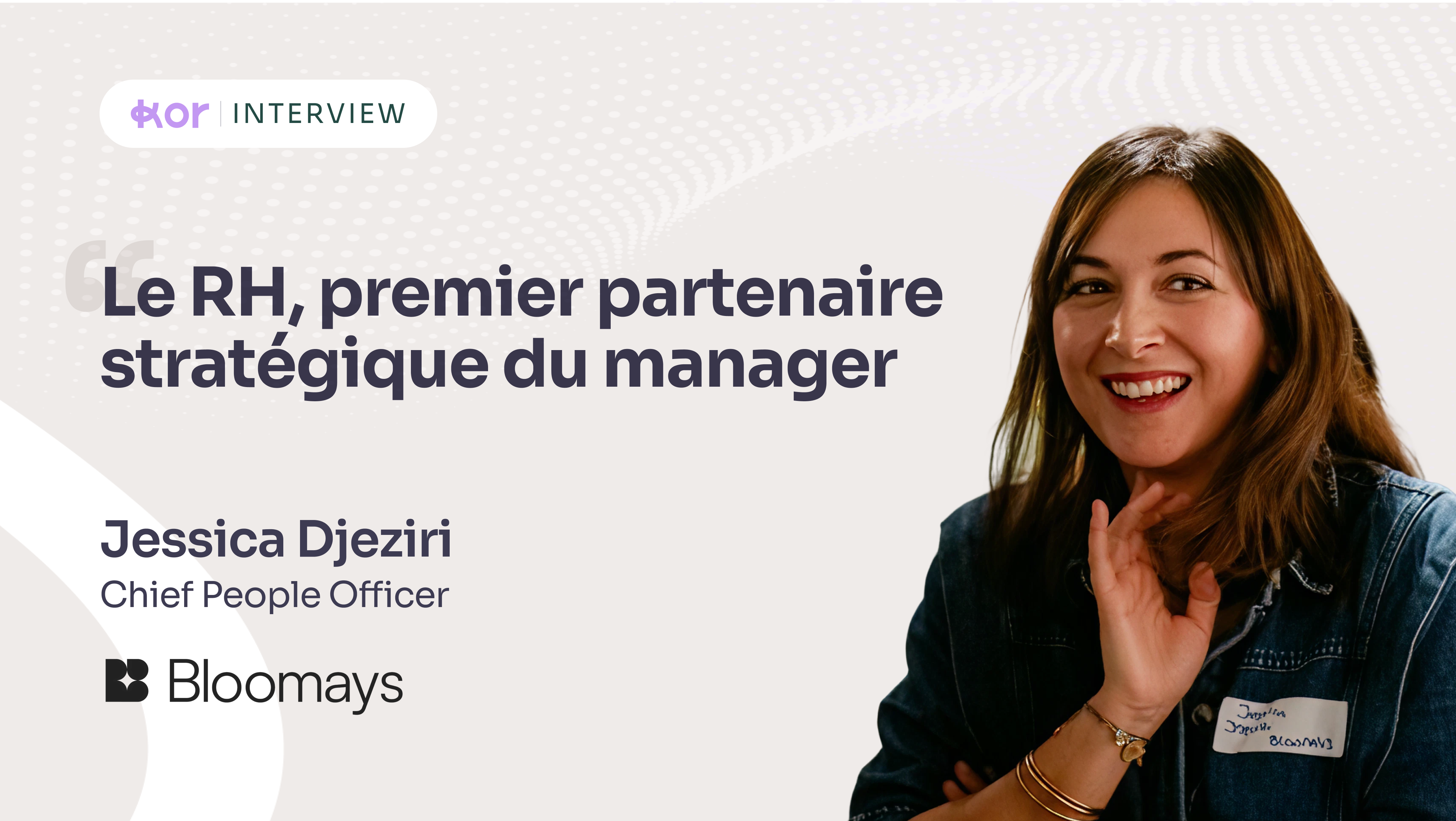
Jessica Djeziri has spent over 15 years building and leading HR functions in tech scale-ups — Chief People Officer at Ornikar, HR Director at Shift Technology and PhotoBox, among others. Today, as Chief People Officer and partner at Bloomays, an HR consulting firm, she advocates for a business-centric view of the profession: HR isn't a support function — it's a strategic partner. Provided they are given the space to be one.
Introduction
Jessica Djeziri doesn't mince words. When asked about the role of HR in a company, she's direct: "There will always be administrative tasks in our job — but we truly have more influence, we can bring more to the organization, provided we're given that space."
In this discussion with Sophie Agosta, co-founder and CEO of Kor, she elaborates on what it concretely entails to implement a corporate health program: how to get managers on board, how to convince the COMEX, and why HR often tends to operate in a black box.
"Managers are the primary HR for their teams"
Sophie: HR has long been perceived as a support function. Is that changing?
Jessica: It is evolving, yes — but it's not that straightforward. HR teams aren't necessarily well-staffed to play this role. And we're not always given the space either. So there's an educational effort I've often had to make, and which, unfortunately, is still frequently necessary. However, I believe we shouldn't force things: either we want to work together, or we don't. If we want an HR professional to succeed in their role, they need to be given space, given the keys. We can define a framework, of course — but they must be given the means, especially the right tools that will help lighten their workload.
Sophie: And managers in all of this — what's their role?
Jessica: Central. We had this maxim: managers are the primary HR for their teams. They are the relays. Once a policy or program is created — health, engagement, performance — the tragedy for HR is being the only ones to carry it. Our role is to equip these managers, to give them the information so that when an issue arises, they have the tools to react and guide.
This is even truer in large organizations. At Orange, when an employee had an issue, their first point of contact wasn't the HR Director — it was their manager. The problem is that managers weren't always sufficiently equipped by HR to play this role.
Implementing a Health Program: The Three Levels
Sophie: Practically speaking, if a company wants to implement a health check-up for its employees, where does it start?
Jessica: I always have three levels of communication: the COMEX, managers, and employees. The COMEX needs to be on board themselves first – we can't ask middle management to do this if the COMEX isn't fully committed. Then, I would take a test group, a group of beta testers, to act as my ambassadors. It's a bit like A/B testing or focus groups: it allows me to test my communication and get feedback. And only after that do we roll it out to all employees.
Sophie: And social partners – the Works Council (CSE), unions – when do you involve them?
Jessica: For effective social relations management, I would inform them as early as possible. It costs nothing, but it also shows that we're not working in a black box. HR tends to build things in isolation, and then we wonder why people don't adopt the solution. Social partners are a means of dialogue with employees – involving them early on, getting their feedback, ensures the service provider can start under favorable conditions.
Convincing the COMEX: Data is the Key
Sophie: How do you convince a leader who doesn't yet see the problem – absenteeism, employee health?
Jessica: Through data – internal company data. What is the level of absenteeism? Are there recurring illnesses? High-risk professions? This internal analysis needs to be done first. Also by sector – if you're addressing catering, hospitality, or industry, there are undoubtedly very telling statistics on sick leave.
Don't Tackle the Issue Alone
Sophie: What if no one brings up health issues with you – the leaders don't see the problem?
Jessica: It's up to us to educate, to raise awareness about these issues, and to show how they impact the organization. But the most important thing is not to be alone. Don't embark on a solo mission without checking if people are on board. If no one follows, you have to ask yourself: is this the right project? Is this what was expected of me as an HR Director?
I experienced this with diversity — I was a bit on my own. It was quite tough. Eventually, I found an ally on the topic, and then it spread. It's important not to be alone on issues that cut across the entire organization.
Measure — and not just once a year
Sophie: Once the program is launched, how do we ensure it's working?
Jessica: We measure regularly. Employees are starting to get tired of repeated surveys. We can integrate follow-up questions into existing ones, or address them in workshops. There are also recurring moments — one-on-ones, workload discussions, for example. These are already opportunities to gather information.
At Bloomays, we have a bi-weekly check-in — to take the pulse of the "sprint" that just finished. I find that more interesting than an annual survey. We don't always need dedicated software to measure the effectiveness of our programs — it can be done through regular feedback channels between teams and managers — but it's truly crucial to genuinely care about employee engagement.
“Our role as HR is literally to be a partner to managers on these topics. My associate was a CTO for 25 years without ever speaking to a single HR person — and I find that sad, because for me, that's our raison d'être.”
— Jessica Djeziri



.avif)

.avif)